Family preparedness guide
What to put on an emergency contact card
Last updated Oct 2026
Most of us keep every important number inside our phones. That works fine until a phone dies, gets lost, or a child has to borrow someone else's. A small paper card with the essentials is a simple backup, and it takes about fifteen minutes to make.
Ready.gov and the American Red Cross both recommend that families write down their emergency contacts and meeting places and keep a copy with each person. Here is what to include and how to keep it useful.
The checklist
Keep it short enough to read at a glance. For each person's card, include:
- The person's name and one parent or guardian phone number
- A second local contact who can pick up a child if you can't
- An out-of-area contact (more on this below)
- Your neighborhood meeting place and an out-of-neighborhood meeting place
- Your home address, so a child or helper can give it to someone
- Key medical notes: allergies, conditions or medicines a responder should know about
- Your doctor's or pediatrician's number, if there is room
- Local emergency number and Poison Help (1-800-222-1222 in the US)
Write phone numbers in full, with area codes. In a stressful moment nobody wants to guess.
Pick an out-of-area contact
Choose a relative or friend who lives in another town or state. When local lines are busy, it is often easier to reach someone far away, and that person can become the family's message center: everyone checks in with them, and they pass updates along. Ask them first, make sure they're comfortable with the role, and remind everyone that a short text often gets through when a call won't.
Agree on meeting places
Ready.gov suggests planning more than one spot. Pick one place just outside your home, such as a neighbor's mailbox or a big tree, for sudden events like a fire. Then pick a second place outside your neighborhood, like a library or a relative's house, in case you can't get home. Walk or drive there once so the kids know what it looks like.
Where to keep it
The best card is the one that is with the person when they need it. Good spots:
- Tucked inside a phone case, behind the phone
- In a wallet, a backpack pocket or a lunch box
- In your go-bag and your car
- On the fridge, for babysitters and visitors
Give a copy to anyone who regularly cares for your kids, and let older children practice reading it out loud.
When to update it
A card with an old number is worse than no card at all. Review it whenever something changes: a new phone number, a move, a new school or daycare, a new medicine or allergy, or a new babysitter. It also helps to pick a regular check, such as the start of each school year or when the clocks change. Swap in fresh copies and recycle the old ones so nobody grabs outdated information.
Make yours tonight
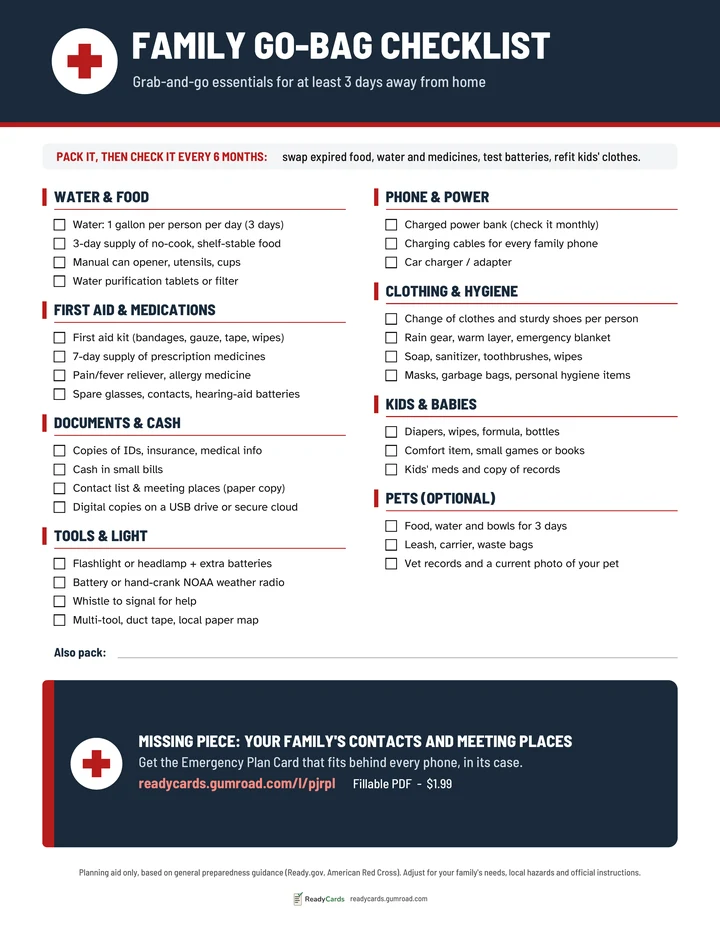
You can write all of this on an index card, and that's a fine start. If you'd like a tidy version that folds to fit behind a phone, our Family Emergency Plan Card is a fillable PDF you can type into or print and write by hand. And to pack the rest of your family's bag, grab the free Go-Bag Checklist.
See the Family Emergency Plan Card
Sources
- Ready.gov: Make a Plan and Build a Kit
- American Red Cross: Make a Plan
This guide is a planning aid, not professional advice.